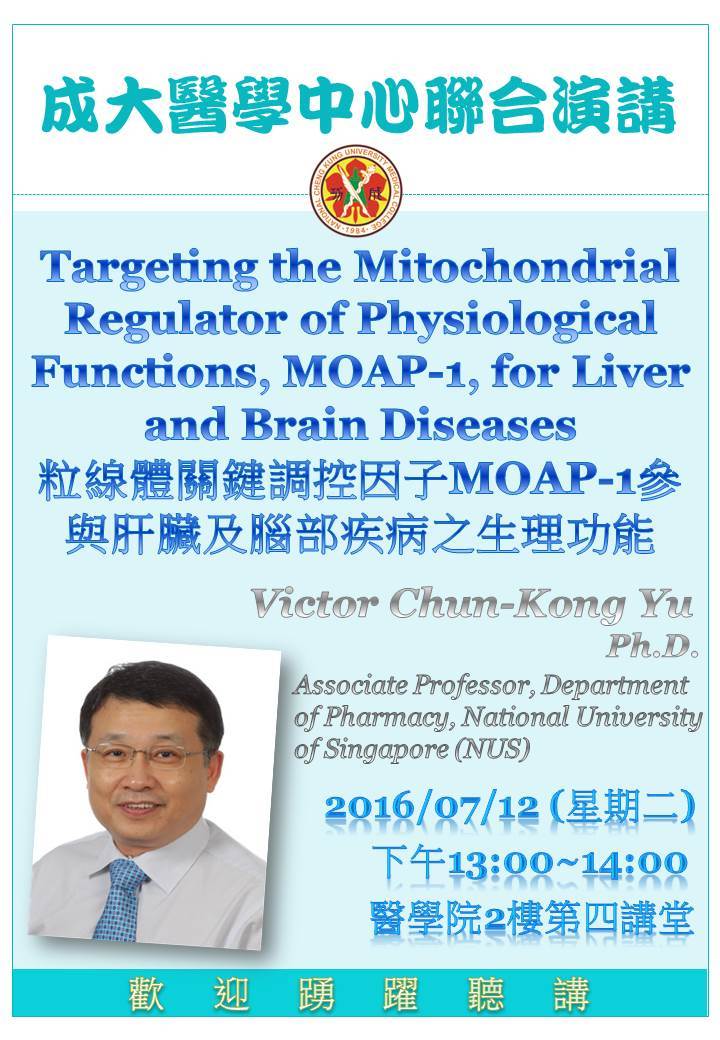
《7/12醫學中心聯合演講》Victor Chun-Kong Yu, Ph.D.- Targeting the Mitochondrial Regulator of Physiological Functions, MOAP-1, for Liver and Brain Diseases
Targeting the Mitochondrial Regulator of Physiological Functions, MOAP-1, for Liver and Brain Diseases
Mitochondria are dynamic organelles that are constantly undergoing fusion and fission. Although mitochondria are known for playing key function in energy production by producing ATP for cells, many important physiological regulators localized at mitochondria have been identified that they play diverse roles in regulating broad range of physiological functions such as apoptosis, metabolism, inflammation, autophagy and necrosis. Apoptosis is a physiological process by which unwanted, damage or infected cells are to be eliminated from multi-cellular organisms. Improper activation or deactivation of mitochondrial apoptosis signaling has been linked to a plethora of major human ailments facing the ageing population worldwide, ranging from neurodegenerative diseases to cancers. We have been interested in identifying and studying crucial proteins in mitochondria that regulates cell death and other signalling. In this talk, I will focus our recent work on characterizing the physiological roles of the Bax-binding protein, MOAP-1, in regulating cell death and possibly other key mitochondrial functions in liver and brain using combined genetic, biochemical and cell biology approaches. Brief Biography Victor Chun Kong YU was born in Hong Kong. He obtained his B.Sc. (Pharm, Hons) in 1982 from University of Houston and Ph.D. (Pharmaceutical Chemistry) in 1987 from University of California, San Francisco where he spent five years to investigate the molecular mechanism of morphine. In his postdoctoral work, he had studied the mechanism of actions of a class of hormone receptors known as nuclear hormone receptors. Dr. Yu made his first major discovery during this period of time by identifying the nuclear receptor, RXR, as the common co-regulator for the Vitamin D, Vitamin A (Retinoic acid) and Thyroid hormone receptors. He went to Singapore in 1993 and had been at the Institute of Molecular and Cell Biology (IMCB) until he joined Department of Pharmacy at the National University of Singapore in August, 2009. His current research focus is on studying the mitochondrial cells.