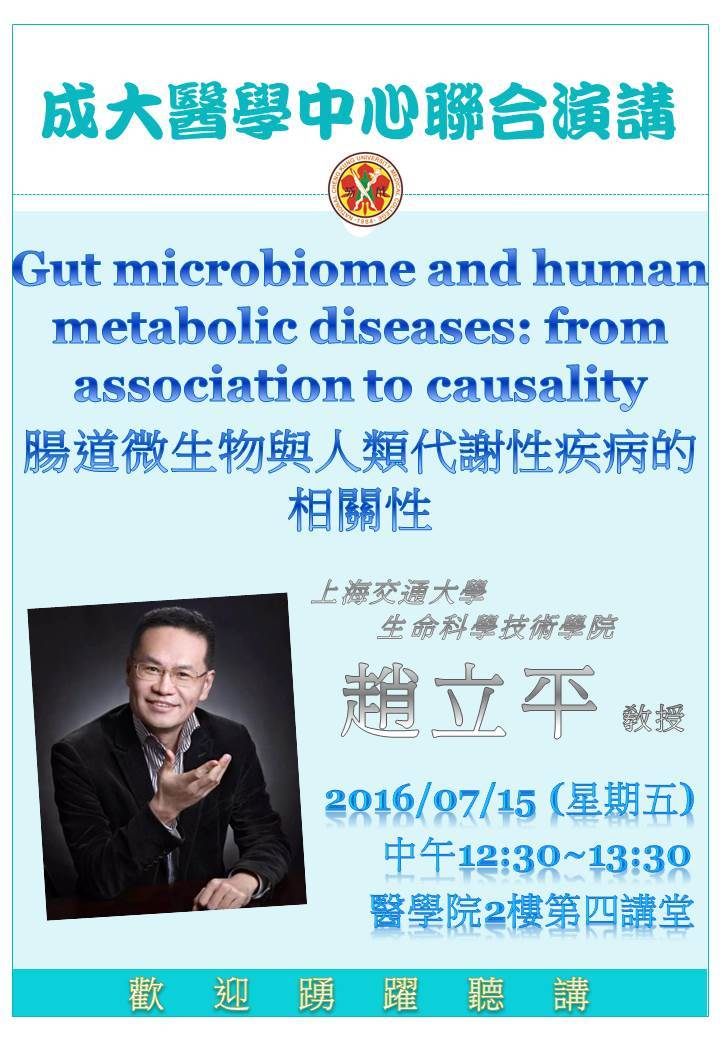
《7/15醫學中心聯合演講》趙立平教授- Gut microbiome and human metabolic diseases: from association to causality】
Prof Liping Zhao got his PhD in 1989 from Nanjing Agricultural University and worked in Cornell University as visiting scholar from 1993-1995. He is currently a distinguished professor for microbiology and the director of Laboratory of Microbial Ecology and Ecogenomics in School of Life Sciences and Biotechnology, Shanghai Jiao Tong University. He is the director of the Laboratory of Nutritional Systems Biology in Shanghai Center for Systems Biomedicine. He is also the director the SJTU-Perfect (China) Joint Research Center on Microbiota and Health.
He was executive director for Shanghai Center for Systems Biomedicine from 2005-2009. He was associate dean for School of Life Sciences and Biotechnology from 2003-2013. He served as a Board member of the International Society for Microbial Ecology from 2006-2012. He is a current editorial board member of FEMS Microbiology Ecology, Scientific Reports, and a senior editor of the ISME Journal. He was elected the fellowship of American Academy of Microbiology in 2014.
His team has been applying molecular and genomic tools for systems understanding and predictive manipulation of the complex microbial communities in human and animal guts. They have published more than 40 research papers in PNAS, Nature Communications, ISME Journal, AEM, FEMS Microbiology Ecology etc. He also published reviews in Nature Reviews Microbiology, Journal of Proteome Research, Molecular Aspects of Medicine etc. He has been invited to give keynote and plenary talks in ASM general conference, ISME conference etc.
Liping has contributed significantly to the understanding of the role of the interactions between nutrition and gut microbiota in obesity and related metabolic diseases. As the first example of using the logic of Koch’s postulates as a conceptual framework for demonstrating the causative role of specific members of the gut microbiota in obesity, he showed that one endotoxin- producing opportunistic pathogen isolated from an obese human gut causes obesity in germfree mice. He shows that traditional Chinese medicine and medicinal foods can help control obesity/diabetes with gut microbiota as a drug target, opening new avenues for managing the devastating epidemic of metabolic diseases. The SCIENCE magazine featured a story on how he combines traditional Chinese medicine and gut microbiota study to understand and fight obesity (Science 336: 1248).