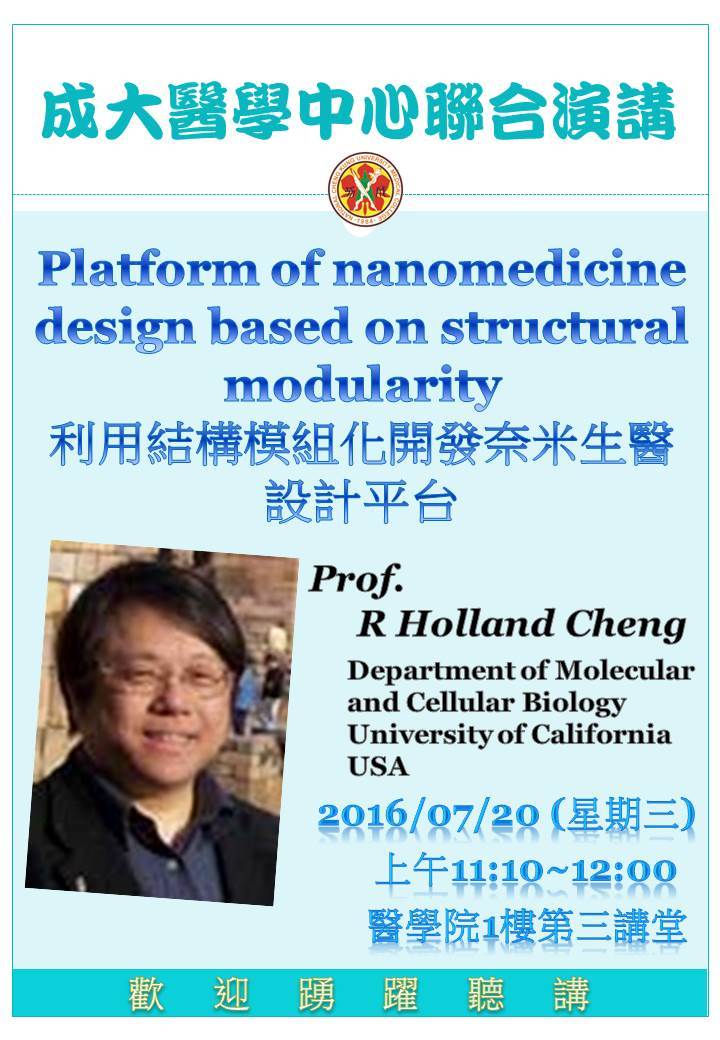
《7/20醫學中心聯合演講》Prof. R Holland Cheng - Platform of nanomedicine design based on structural modularity
R Holland Cheng's research aims to understand the structure and function of macromolecular interactions by selected model macromolecular systems. He has been studying structures and assembly of viruses including interactions of membrane proteins and viruses for more than two decades. He has published two edited books and numerous peer-reviewed papers. As his research aims to understand the structure and function of macromolecular interactions by selected model macromolecules, R Holland Cheng's enduring efforts have yielded substantial and impactful findings in the life cycles of picorna viruses (such as echovirus, rhinovirus, hepA virus), as well as details on viral membrane proteins by tomography and single particle reconstructions to unveil the role of membrane proteins in cell-virus (HIV, alpha viruses) interactions. Using cryo-electron microscopy, the cell response to the infectious virions can be studied to gain insights of receptor-binding mediated metastable conformations, a built-in flexibility triggered by cellular events. Algorithms of image processing are constantly developed to retrieve most of the useful images acquired by cryo-electron microscopy or cellular tomography. R Holland Cheng has been conducting Institutional research programs on proteome imaging of macromolecular systems, involving a University Alliance of quantitative biology with emphasis on biomedical imaging. He has been fully aware of the importance of effective communication among project members in fulfilling successful research plan, time lines and budget, since the starting of his lab and research program in Karolinska Institute, Sweden in 1996. He has a demonstrated record of accomplished and productive research projects in an area of controlling viral capsid assembly and manipulations to serve the proposed project for combating the infectious diseases.